
Short answer: blue tongue skinks (also called blue tongue lizards) are omnivores. A healthy adult diet is roughly half leafy greens and vegetables, about 40% protein such as gut-loaded insects, snails or lean cooked meat, and no more than about 10% fruit, with a pinch of calcium powder once a week. Babies eat every day and need more protein; adults over about 8 months eat only once or twice a week. Use the
Table of Contents
Blue Tongue Lizard Food List (Quick Table)
| Food group | Good staples | Occasional only | Do not feed |
|---|---|---|---|
| Leafy greens | Collard greens, mustard greens, turnip greens, dandelion greens, endive, escarole | Parsley, kale | Plants or weeds sprayed with pesticide |
| Vegetables | Squash, green beans, cactus pad, borage | Bell pepper, carrot, broccoli, zucchini, cucumber, sweet potato or yam | Onion, eggplant, rhubarb |
| Insects and invertebrates | Dubia roaches, black soldier fly larvae, silkworms, hornworms, snails (captive-bred) | Crickets, mealworms, superworms, waxworms, butterworms | Wild-caught insects, fireflies (lightning bugs), scorpions |
| Meat and egg | Lean ground turkey, chicken or beef (cooked) | Boiled or scrambled egg, chicken heart or liver, thawed pinkie mice | Fatty, seasoned or processed meat |
| Fruit (max ~10%) | Berries, papaya, mango, fig, melon | Banana, grapes, apple, pear | Avocado, citrus, fruit pits and seeds |
| Supplements | Calcium powder (with D3 if there is no UVB lamp) | Reptile multivitamin about every 2 weeks | Doubling up on D3 if you already have strong UVB |
How Often to Feed a Blue Tongue Skink by Age
| Age | How often | Diet mix | Calcium dusting |
|---|---|---|---|
| Baby (0–3 months) | Every day (every other day from about 2 months if appetite drops) | About 50% insects, 50% greens, vegetables and a little fruit | Twice a week |
| Sub-adult (3–8 months) | Every 2–5 days | About 40–50% protein, the rest mostly greens and vegetables | Twice a week |
| Adult (8+ months) | 1–2 times a week | About 50% greens and vegetables, 40% protein, 10% fruit | Once a week |
A typical meal is about 1–2 tablespoons of chopped

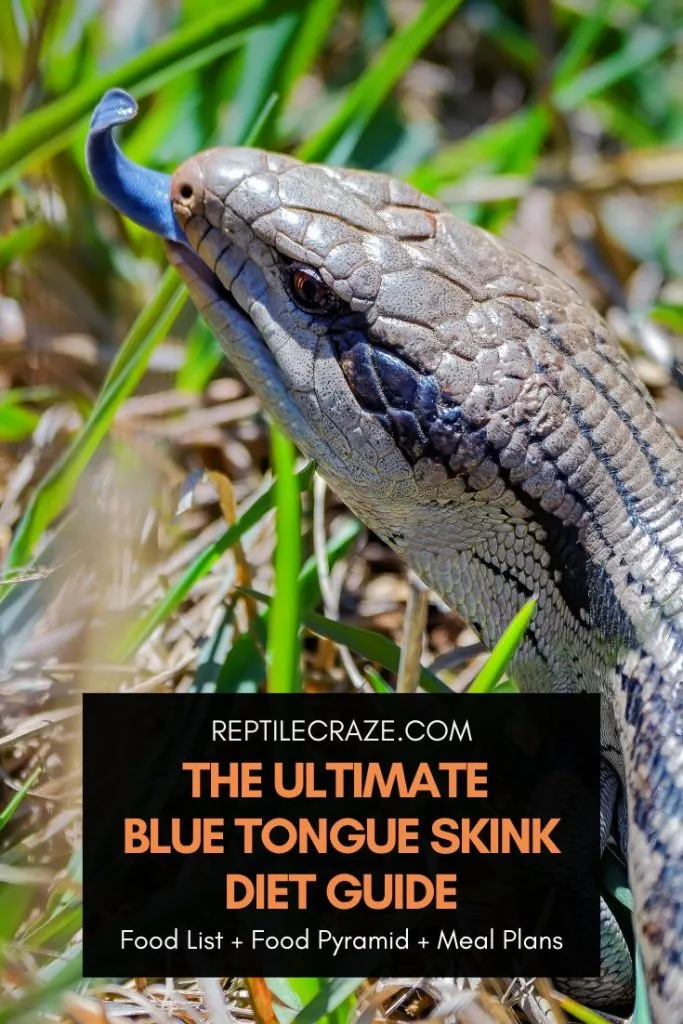
What should you feed your blue tongue skinks? Is it okay to give them your leftover vegetables or even prepare them a fruit bowl? Should you grow a feeder insect colony? Are there foods that are toxic to blue tongue skinks?
Blue tongue skinks are omnivorous reptiles, so their diet consists of fruits, vegetables, and insects. Their meal should also include calcium for proper bone growth. You need to alternate these
What fruits and vegetables can you give your blue tongue skink? Do they prefer insects more than their greens? We are going to discuss these and more, so if you need a feeding guide for your blue tongue skink, just keep reading.
Blue Tongue Skink Diet
We mentioned earlier that blue tongue skinks are omnivorous. So just like humans, they eat various fruits, vegetables, and a source of protein.
However, just like other reptiles, they also need Calcium which they can get from reptile calcium powders.
In this study, it was found that the natural diet of blue tongue skinks in the wild mainly consists of vegetables and fruits.
There were low frequencies of finding arthropods in the systems of the blue tongue skinks that were observed.
Blue Tongue Skink Food Pyramid

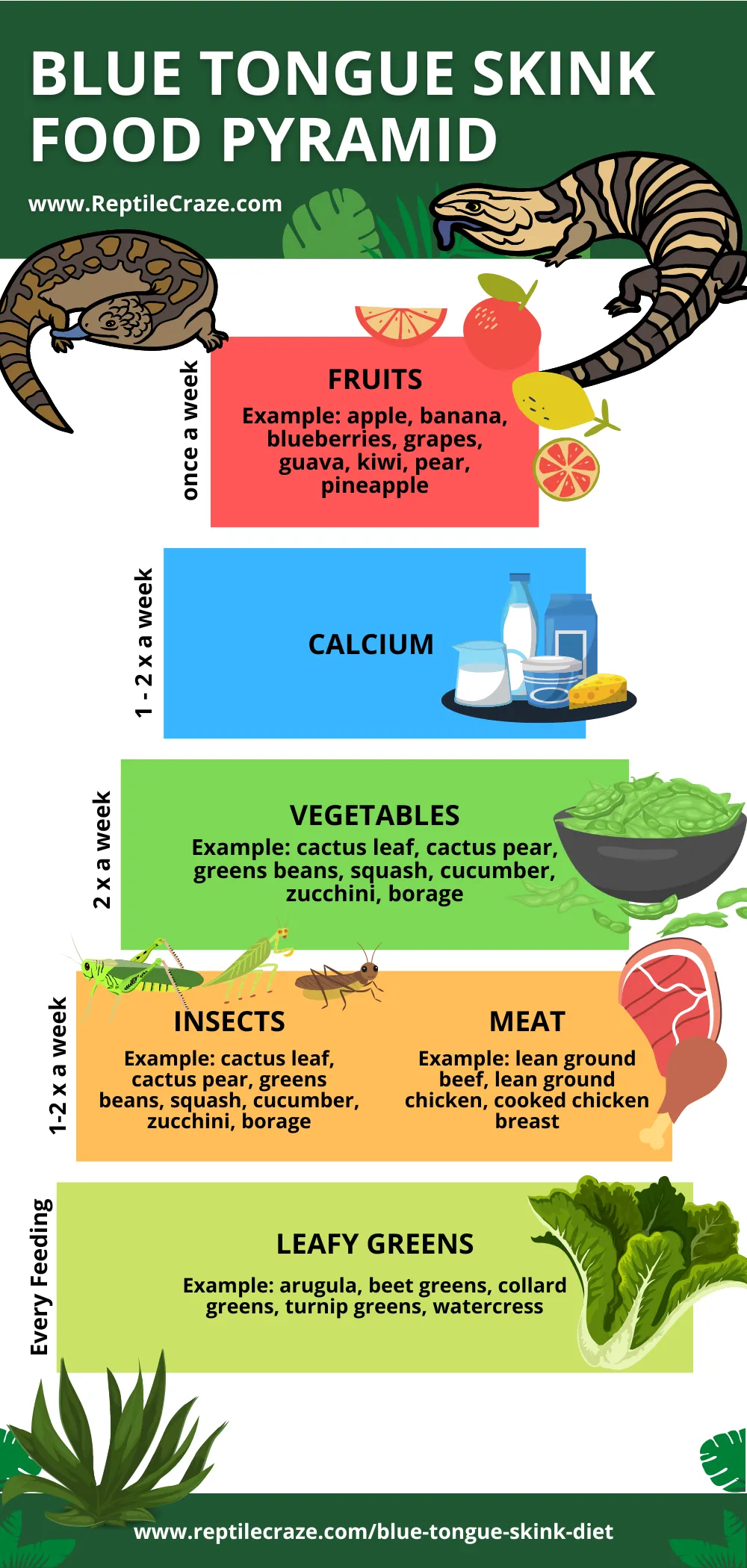
The arthropods aka the protein that was found in their system mainly consisted of beetles and insect larvae.
On the other hand, there is an onset of discussion surrounding the fact that captive blue tongue skinks have started to prefer insects over vegetables.
This can be attributed to captive care. As more and more blue tongue skinks are born in captivity and are given extra protein (insects) to bulk them up to be ready for selling, they developed a liking for insects.
Keep in mind that you should not only feed insects to your blue tongue skink as this is not a balanced diet.
Tip: There are blue tongue skinks that refuse to eat even if you are following their diet requirements. If this is your case, read our article here to find out what you can do to make your blue tongue skink eat.
How Often Do You Feed A Blue Tongue Skink?
Adult blue tongue skinks (over 8 months old) can be fed 1 to 2 times a week. The recommended amount is 1 to 2 tablespoons. As blue tongue skinks get older, you will notice that they eat less as now they have more fat storage.
Sub-adult blue tongue skinks (3-8 months) can be fed every 2 to 5 days. The feeding amount is also 1-2 tbsps.
Keep in mind that even though they are omnivorous, blue tongue skinks have a slow metabolism so they do not need to feed as much as an omnivorous mammal.
They may not even finish everything even if you gave them the suggested amount. Still, it is better to give them the recommended amount, and just let them decide if they eat all of it or not.
How Often Do You Feed A Baby Blue Tongue Skink?
Baby blue tongue skinks (0-3 months) have a drastically different feeding schedule as opposed to sub-adults and adults. Simply because they are still growing and developing their body systems.
They have to be fed daily, with the suggested amount being 1-2 tbsps. Some eat less when they are about to reach 2 months, during this time, you can lower the frequency of feeding to every 2 days.
Blue Tongue Skink Meal Plan
Tip: Save this meal plan to your computer or share it on social media!

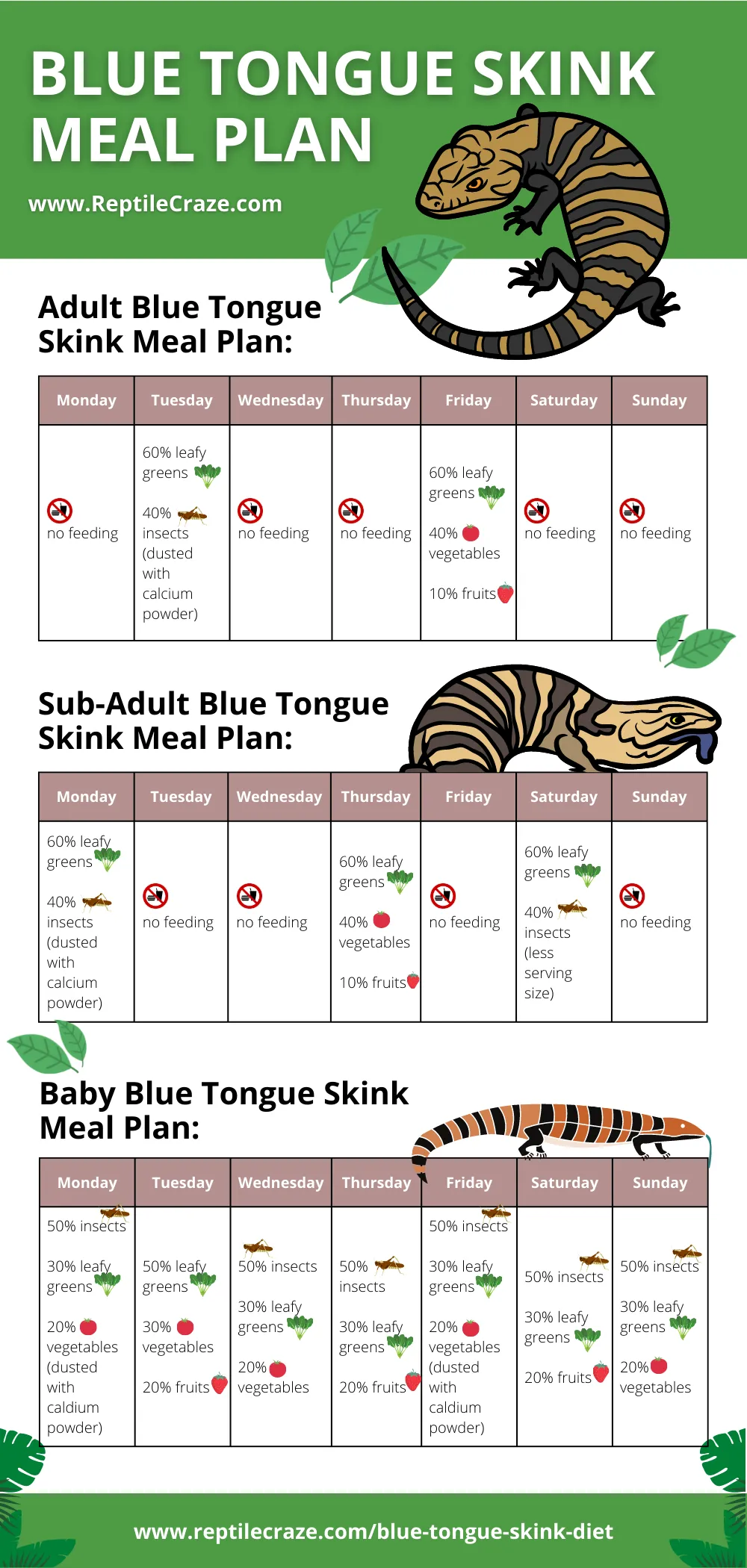
Adult Blue Tongue Skink Meal Plan:
| Monday | Tuesday | Wednesday | Thursday | Friday | Saturday | Sunday |
| no feeding | 60% leafy greens 40% insects (dusted with calcium powder) | no feeding | no feeding | 60% leafy greens 30% vegetables 10% fruits | no feeding | no feeding |
Sub-Adult Blue Tongue Skink Meal Plan:
| Monday | Tuesday | Wednesday | Thursday | Friday | Saturday | Sunday |
| 60% leafy greens 40% insects (dusted with calcium powder) | no feeding | no feeding | 60% leafy greens 30% vegetables 10% fruits | no feeding | 60% leafy greens 40% insects (less serving size) | no feeding |
Baby Blue Tongue Skink Meal Plan:
| Monday | Tuesday | Wednesday | Thursday | Friday | Saturday | Sunday |
| 50% insects 30% leafy greens 20% vegetables (dusted with calcium powder) | 50% insects 30% leafy greens 20% fruits | 50% insects 30% leafy greens 20% vegetables | 50% insects 30% leafy greens 20% fruits | 50% insects 30% leafy greens 20% vegetables (dusted with calcium powder) | 50% insects 30% leafy greens 20% fruits | 50% insects 30% leafy greens 20% vegetables |
Can Blue Tongue Skinks Eat Fruits?


Yes, blue tongue skinks can eat fruits. However, fruits should only be given occasionally or given as a treat. Make sure to give them a variety of fruits so they will not get bored with their weekly treat. Keep in mind that fruits should only consist of 10% of their diet.
Note: Do not feed them citrusy fruits, pits, seeds, avocado, and rhubarb. These may give them stomach problems.
Here are your choice of fruits:
- Apple
- Apricot
- Bananas
- Blackberries
- Blueberries
- Cantaloupe
- Cherries
- Fig (in moderation)
- Grapes
- Guava
- Honeydew
- Kiwi
- Mango (in moderation)
- Nectarines
- Papaya (in moderation)
- Peaches
- Pear
- Pineapple
- Plums
- Pomegranate
- Raspberries (in moderation)
- Starfruit
- Strawberries
- Watermelon
It is also important that you cut these fruits into small pieces. Some owners blend the fruits and freeze them. They just thaw the frozen fruit come feeding time.
Can Blue Tongue Skinks Eat Vegetables?


Yes, blue tongue skinks can eat vegetables. In fact, adult blue tongue skinks should have 40-50% of vegetables in their diet. As for baby blue tongue skinks, it is 20-30%.
Tip: If you want to know what plants you can put in a blue tongue skink
tank (that are also safe for them to eat) read our article here!
The problem is that sometimes, blue tongue skinks do not eat their vegetables (just like humans). A solution to this is mashing them and mixing them with their leafy greens or insects.
Note: Do not feed them onions, eggplants, azalea flowers, daffodils, hemp leaves, lily of the valley, and tulips. These are toxic to them.
Here are your choice of vegetables:
- Asparagus (occasional)
- Beets (occasional)
- Red, green, and yellow bell peppers (occasional)
- Borage
- Broccoli (occasional)
- Brussels sprouts (occasional)
- Cactus leaf/pad/pear
- Carrots (occasional)
- Cauliflower (occasional)
- Celery (occasional)
- Corn (occasional)
- Cucumber (occasional)
- Green beans
- Green peas (in moderation)
- White mushrooms (in moderation)
- Okra (occasional)
- Parsley (occasional)
- Parsnip (in moderation)
- Potato
- Radish (occasional)
- Squash
- Tomatoes (occasional)
- Yams (in moderation)
- Yucca root (occasional)
- Zucchini (occasional)
Can Blue Tongue Skinks Eat Meat?


Blue tongue skinks can also eat meat as it is a good source of protein. However, it is important to know that meat should never take the place of feeder insects. Therefore, when preparing their
You might have heard about owners feeding their blue tongue skinks dog
Here are your choice of meats:
- Lean and ground beef (in moderation)
- Lean and ground chicken (in moderation)
- Lean and ground duck (in moderation)
- Lean and ground rabbit (in moderation)
- Lean and ground venison (in moderation)
- Lean and ground lamb (in moderation)
- Cooked chicken breast (in moderation)
- Cooked chicken liver/heart (in moderation)
- Raw/boiled/scrambled egg (in moderation)
- Frozen or live pinkies (occasional)
- Fish chunks (occasional)
Make sure that you correctly prepare frozen items. Thaw them at least 30 minutes before feeding. You can submerge it in hot water in order to mimic the temperature of a warm living body which is about 98-100 F.
What Insects Do Blue Tongue Skinks Eat?


Blue tongue skinks also eat insects. They are also a good source of protein, vitamins, and minerals. Make sure to gut load your feeder insects at least 24 hours before feeding.
Feeder insects are the preferred protein choice in the diet of a blue tongue skink because it is also a good exercise for them as well as a form of enrichment.
Note: Do not feed them wild caught insects, lightning bugs, and scorpions.
Here are your choice of insects:
- Butterworms (in moderation)
- Black soldier fly larvae
- Dubia roaches
- Crickets (occasional)
- Earthworm
- Grasshoppers (occasional)
- Hornworm
- Locusts (occasional)
- Mealworm (occasional)
- Phoenix worm (in moderation)
- Silkworm
- Snails
- Superworms (in moderation)
- Waxworms (in moderation)
Do Blue Tongue Skinks Need Calcium?
Calcium is essential to the diet of a blue tongue skink. It helps with their bone growth and strength. Therefore, a pinch of calcium powder can do the trick.
For adult blue tongue skinks, you can give them a pinch of calcium powder once a week. For sub-adults and baby blue tongue skinks, you can give them calcium powder twice a week.
Keep in mind that if you do not have UVB lighting, you should give them Calcium powder that has Vitamin D3.
Blue Tongue Skink Diet FAQ
What do blue tongue lizards eat?
Blue tongue lizards and blue tongue skinks are the same animals, and they eat a mixed diet: leafy greens and vegetables, insects and snails, some lean meat or egg, and a small amount of fruit. Wild skinks eat a lot of plant matter, so greens should never be skipped in favor of insects only.
Can blue tongue skinks eat dog food or cat food ?
Many keepers use a high-quality, grain-free wet dog or cat
What foods are toxic to blue tongue skinks?
Avoid avocado, rhubarb, onion, eggplant, citrus fruit, fruit pits and seeds, fireflies, and any wild-caught insects, which can carry parasites or pesticides. Toxic plants such as azalea, daffodil, lily of the valley and tulip should also be kept out of the
How much should I feed my blue tongue skink?
Offer about 1–2 tablespoons of chopped
Do blue tongue skinks need calcium and vitamins?
Yes. Dust
Why won’t my blue tongue skink eat its vegetables?
Skinks raised on lots of insects often pick out the protein. Chop greens finely and mix them with the insects or meat so they can’t be sorted out, and rotate the vegetables so meals stay interesting.
How can I tell if my skink’s diet is working?
A healthy skink has a rounded but not bloated body, a thick tail base, regular sheds and firm, well-formed droppings. Our blue tongue skink poop guide and signs of a healthy blue tongue skink show what to look for.
Final Words
Blue tongue skinks will grow healthy and strong with a balanced diet of leafy greens, vegetables, insects, meat, and fruits. Make sure to mix up their
Further, break down the


- Do Geckos Bite? Species-by-Species Guide - November 25, 2026
- Mouth Rot in Lizards: Signs, Causes and Treatment - November 23, 2026
- Chameleon Health Problems: Common Illnesses & Warning Signs - November 17, 2026